
What each campaign cost, and what came of it
The Paid screens take the results your ad platform reports and put them beside the leads, qualified leads and sales in your own records. You bring the results in as an Ads Manager export or through the API. HeyMySocial reads them and never creates, pauses or changes anything in an ad account.
Reading Meta Ads automatically is built and switched off until Meta has approved the app. The file import works today and needs no connection.
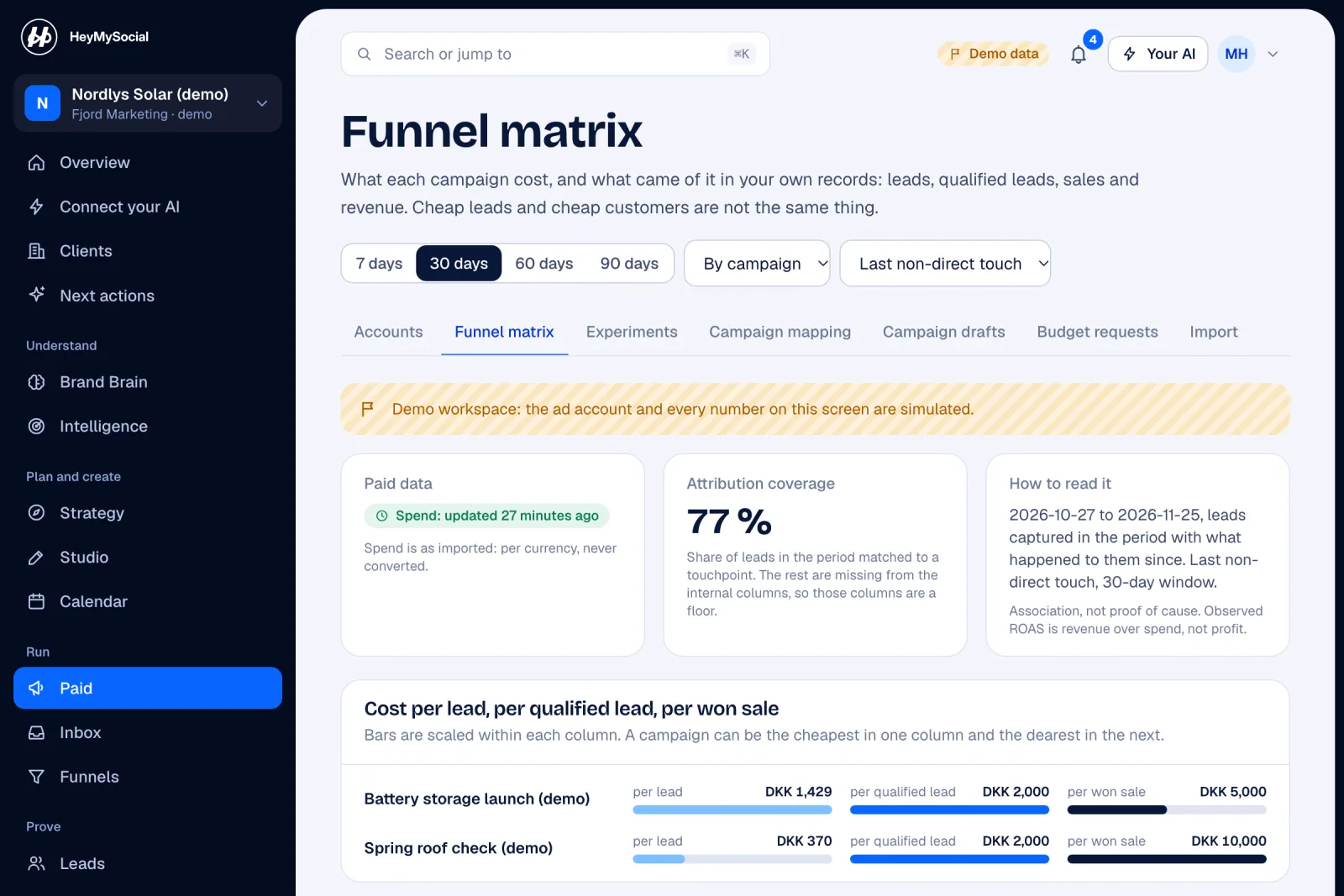
Import an export from Ads Manager
Export a report as CSV and upload it under Paid, Import. Known English and Danish column names are matched for you, and you can change every mapping before anything is stored. Results are kept per account, campaign, ad set and ad, with the period each row covers.
The same rows can be sent by another system through the REST API, or handed to your assistant, which stores them with import_paid_results. All three go through the same importer.
- The currency is read from the file or asked for. It is never guessed, and two currencies are never added together.
- An empty cell is stored as unknown, never as zero.
- Importing the same file twice changes nothing. Rows whose dates overlap older rows for the same ad replace them.
- All clicks and link clicks are kept apart. Leads counted by the platform are stored as platform-reported and never added to the leads matched in your workspace.
- Rows that cannot be read are listed with their line and the reason.
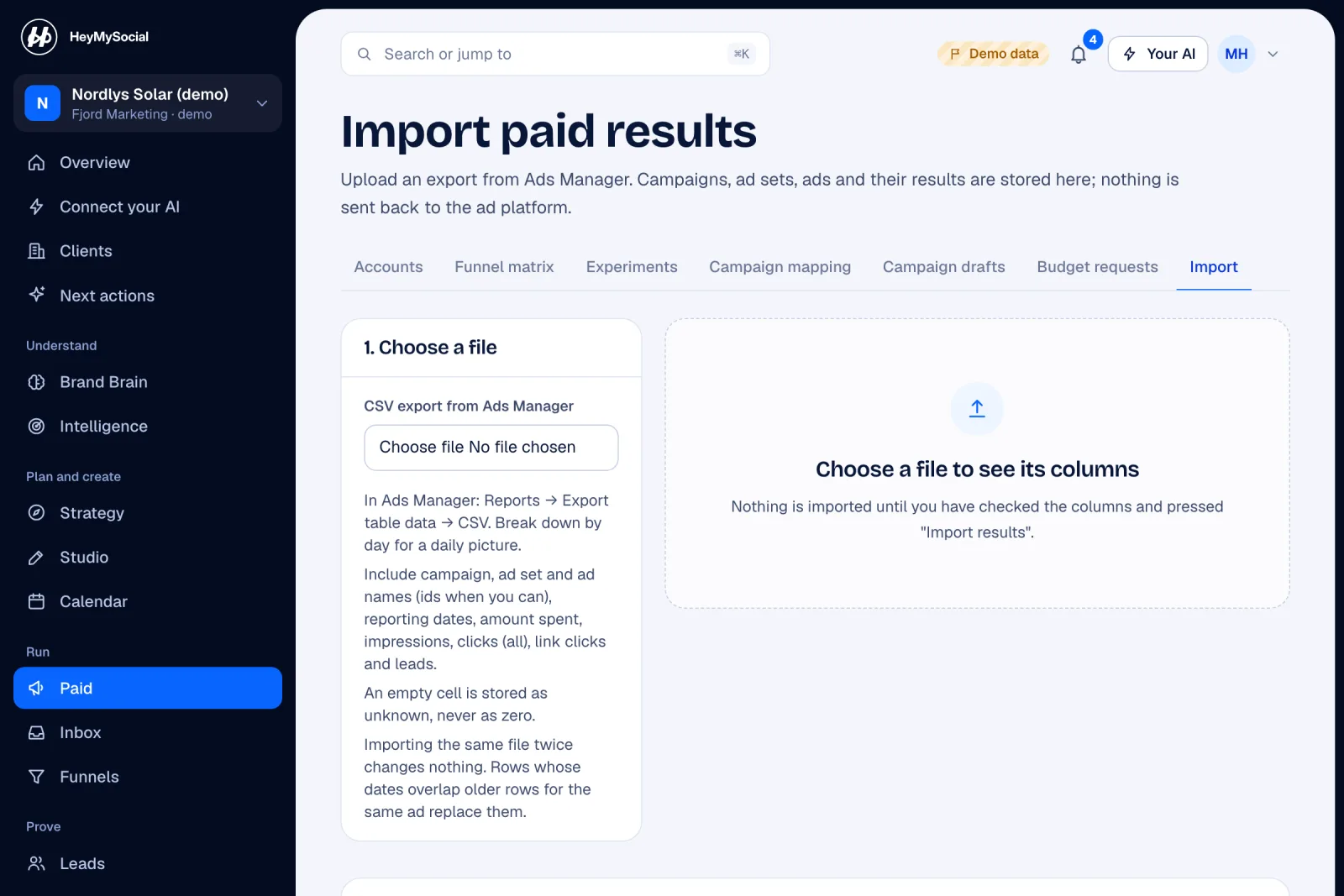
How to read the funnel matrix
One row per campaign or per ad, for the last 7, 30, 60 or 90 days. Leads are matched to campaigns: nothing ties a lead to a single ad yet, so the rows per ad show the platform's numbers and no leads from your own records.
From the ad platform
Spend, impressions, link clicks and the leads the platform counted under its own attribution setting. Imported as they are.
Matched in this workspace
Leads, qualified leads, won sales and revenue from your own records, for the leads captured in the period and what happened to them since.
Cost and return
Cost per lead, per qualified lead and per won sale, and observed ROAS: matched booked revenue over ad spend in the same currency. It is not profit.
Coverage
The share of leads in the period that could be matched to a touchpoint. The rest are missing from the internal columns, so those columns are a floor.
Mapping
An imported campaign counts once it is linked to one of your own campaigns under Campaign mapping. Unlinked spend is left out of every cost metric.
N/A
Shown when a number cannot be worked out: nothing imported, a count of zero, or no outcomes yet. It never means zero.
Experiments that are allowed to say "inconclusive"
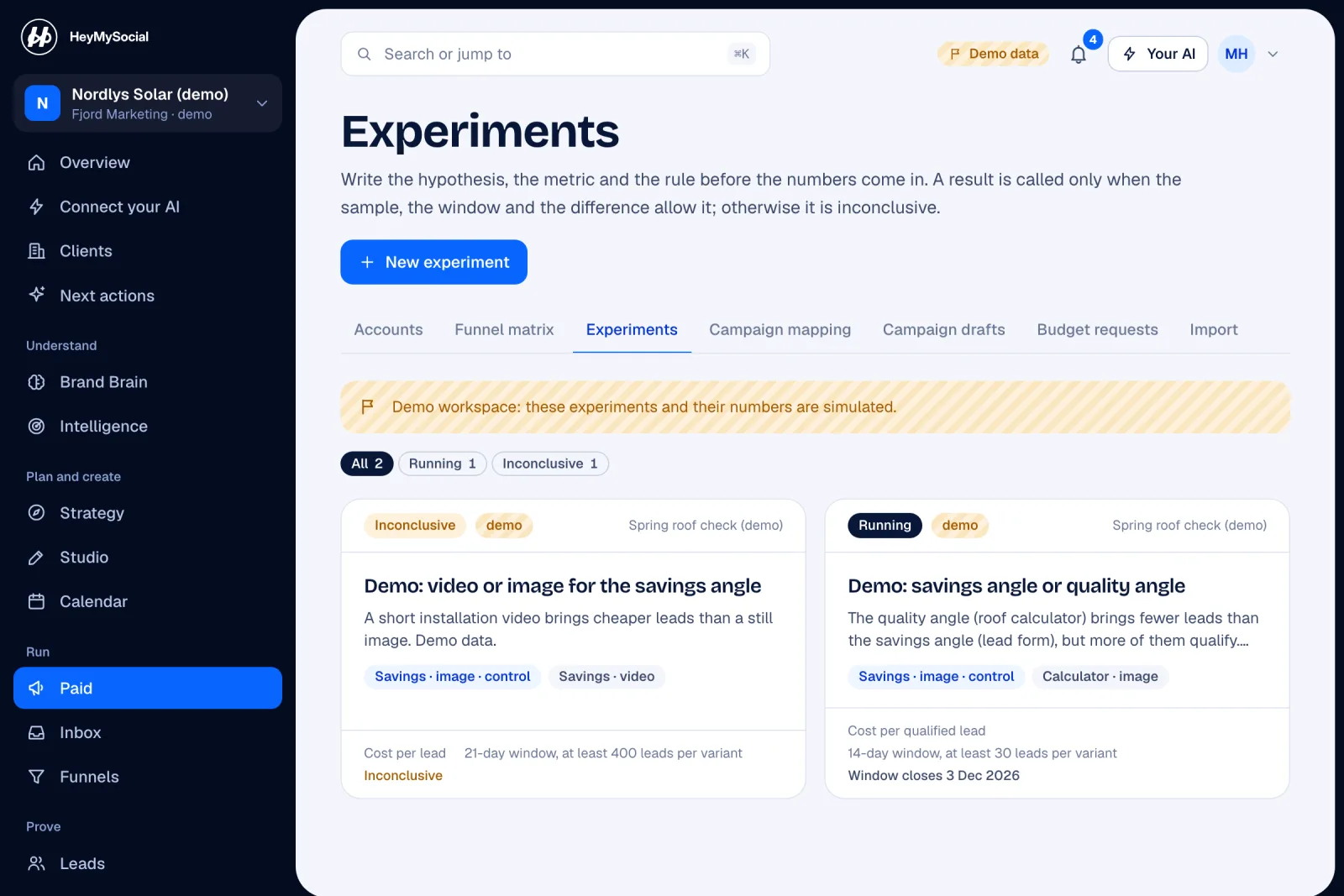
An experiment compares two to six things you already run (ads, posts or tracked links) on one metric. Leads are counted for a variant through the post or tracked link it is linked to; nothing ties a lead to a single ad yet, so a variant linked to an ad counts no leads. You write the hypothesis and the rule before the numbers come in: the comparison window, how long a lead needs to show its outcome, the minimum leads per variant, the smallest difference worth calling and the coverage needed.
Someone approves it, then it is started. Starting changes nothing in any ad account; it only fixes how the variants will be compared. When it is concluded, the evaluator applies the written rule. No significance test is run, and the screen says so.
- The result is "inconclusive" when the window is still open, the leads have not matured, a variant has too few leads, coverage is below the floor, currencies differ, or the difference is inside the threshold.
- A difference is reported as an association. It is read as cause only when the experiment is marked as a randomized split by the ad platform.
- A concluded experiment cannot be reopened.
A budget change is a request, then a file
HeyMySocial never changes a budget. It makes sure the change a person carries out is the one that was approved.
-
1
A paid operator writes the request
For one imported campaign or ad set: the current budget, the proposed budget, a cap and the reason. A proposal above the account maximum or its own cap is refused.
-
2
Someone else approves it
Never the person who asked. The approval is tied to a fingerprint of the exact request. Change the request and it must be approved again.
-
3
Exported for a manual change
The only outcome. An instruction is downloaded as a CSV file, and a person changes the budget by hand in the ad platform.
Campaign drafts leave as a brief and a CSV
A campaign draft holds everything a person needs to set a paid campaign up by hand: objective, budget, dates, audience notes, placements, the ad text, the destination and its tracking. A checklist marks each part as done, worth checking or missing, and a draft with something missing cannot be exported.
"Export for manual setup" produces a print-friendly brief and a CSV. Nothing is sent to an ad platform, and audiences are not created for you. Without a tracked link or UTM values the draft cannot be exported, because leads from the campaign could not be matched to it.
How tracked links tie a lead to a campaignThere is no code in HeyMySocial that changes an ad or a budget.
Not behind a setting and not for an assistant. Results come in; drafts and budget requests go out as files that a person acts on. The adapter for Meta Ads, when it is switched on, asks for the single permission to read.
What your assistant can do with paid results
It imports the rows you give it, maps campaigns, reads the matrix and drafts experiments, campaign drafts and budget requests. It cannot approve a budget, export one or contact an ad platform.
get_experiment
Get one experiment
get_funnel_matrix
Get the funnel matrix
get_paid_draft
Get a paid campaign draft
import_paid_results
Import paid results
list_ad_accounts
List ad accounts
list_budget_requests
List budget change requests
list_experiments
List experiments
list_paid_drafts
List paid campaign drafts
list_paid_performance
List paid performance
manage_experiment
Approve, start, evaluate, conclude or cancel an experiment
map_paid_campaign
Map an imported campaign to one of ours
save_budget_request
Draft or submit a budget change request
save_experiment_draft
Save an experiment draft
save_paid_draft
Save a paid campaign draft
What works today
Questions about paid results
Why do the platform's leads and my leads differ?
Does the matrix prove which campaign caused the sales?
Which ad platforms does the import work with?
How fresh is the data?
Can my assistant change a budget if I ask it to?
Who can see the Paid screens?
Keep reading
See cost per sale, not only cost per lead
Export last month from Ads Manager, import it, and map the campaigns. The demo workspace shows a matrix that is already filled in.